Testing & Data
We do not guess. Every player is tested at the start and again every 6th session — run the same way every time, so the numbers are actually comparable.
Results feed the player’s stats, their level in each individual test, and their overall rank. That is how we find the gap worth training next instead of guessing at it.
See how testing fits into The Extra Hour, our full development system
The eight tests
Every one of these has a fixed standard at each level, and a player has to pass all eight to rank up.
Juggling
Touch quality, rhythm, and how comfortable a player is on the ball with either foot.
What the coach records
- ✓Best juggles, any surface and feet only
- ✓Body-part challenge
- ✓Speed touches in 3 minutes
- ✓14-in-14 reps and the weak-foot ladder
Count challenges get 4 attempts and the best one counts. Timed challenges get a 10-minute window, and the highest clean attempt counts.
Dribbling
Close control, turning, and how much speed a player keeps with the ball at their feet.
What the coach records
- ✓Figure-8 loops
- ✓Cross-dribble loops
- ✓Obstacle shuttle score
Every set is one minute, run separately on the strong foot, the weak foot, and both. The obstacle course runs a cone weave, pole cross, skill-move gates, hurdles, and a minefield out to a turn cone and back — with deductions for touching equipment or using the wrong foot.
Passing
Accuracy, weight of pass, and whether a player can repeat it under a clock.
What the coach records
- ✓Gate passes
- ✓Passes into a colour mini-goal
- ✓Read-the-colour passes
- ✓Passes through a 2-yard gate
One minute per foot. The harder versions add a decision before the pass, so it is never just technique in isolation.
Power
Shot speed — the actual number, on both feet.
What the coach records
- ✓4 strong-foot attempts
- ✓4 weak-foot attempts
The best attempt on each foot counts, and both feet have to clear the standard. A big strong foot does not cover for a weak one.
Distance
How far a player can strike a ball cleanly through the air.
What the coach records
- ✓4 strong-foot attempts
- ✓4 weak-foot attempts
The ball has to be struck in the air and is measured where it first lands, inside a 9-yard alley. Balls that finish outside the alley take a deduction, so distance never comes at the cost of accuracy.
Skill Moves
How many moves a player owns, how many they can chain, and whether they can produce them on demand.
What the coach records
- ✓Different moves executed
- ✓Combos executed
- ✓Live application percentage
- ✓The specific move names
Live application means the coach calls a move or a combo and the player performs it on command — which is the difference between knowing a move and having one.
Shooting Accuracy
Whether a player can actually hit the corners on purpose.
What the coach records
- ✓Bottom corners from inside the box
- ✓Bottom corners from the top of the 18
- ✓All four corners
- ✓The same tests off a moving ball
Ball counts are fixed per drill so the score always means the same thing. Distance goes up, the ball starts moving, and the target shrinks to all four corners as the levels climb.
First Touch
Receiving and killing the ball into a small box, from the ground and out of the air.
What the coach records
- ✓Ground into a 5x5 box — distance reached
- ✓Ground into a 3x3 box, one touch
- ✓Aerial into a 3x3 box
- ✓Aerial into a 3x3 box, one touch
It runs as a ladder: start at 5 yards, move a yard farther after a clean rep and a yard closer after a miss, for 5 minutes. We record how far they got.
Athletic benchmarks, when they are useful
Alongside the eight, we can run athletic tests for players whose limit is physical rather than technical.
5-10-5 Agility
Change of direction and body control over a short shuttle.
Single Leg Hop
Balance, stability, and single-leg power — often where a weak side shows up first.
Custom tests are available too — if a player has a specific goal or a specific problem, we can build an assessment around it.
How the testing cycle works
Testing is not the training. It is the thing that tells us what the training should be.
Baseline
The full test battery at the start, so we know exactly where we are beginning.
Training focus
The numbers point at a weak spot, and that becomes what we actually train.
Retest
Same tests, same setup, every 6th session. The comparison is honest because nothing changed but the player.
Next step
The new numbers decide the next focus. Then it starts again.
Lighter checks in between
Juggling and skill moves are quick enough to fit into a warmup, so we practice them often and officially record them every couple of weeks. The bigger benchmark tests stay at the checkpoints — that is what keeps them meaningful.
The Player Dashboard
All of it — stats, levels, reports, notes, and goals — lives in one place your player and you can open any time. Progress stops being something you have to take our word for.
The home screen
Where your player stands today
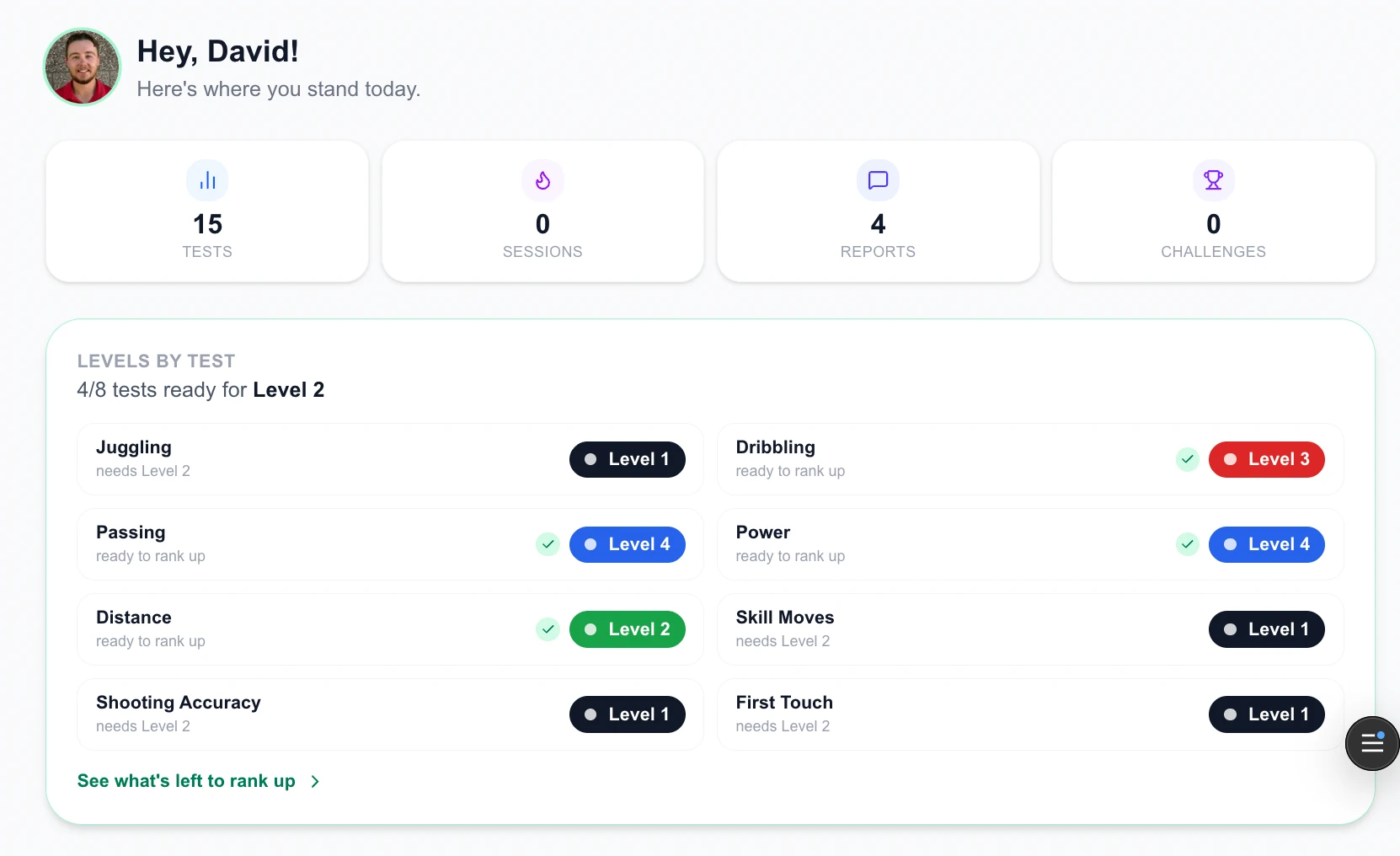
The first thing you see is the honest summary: tests recorded, sessions completed, reports written, and challenges outstanding. Underneath it, every one of the eight tests with the level your player currently holds in it.
- ✓Each test carries its own level, so strengths and gaps are obvious at a glance
- ✓Tests already clearing the next standard are marked ready to rank up
- ✓A running count of how many of the eight are ready
- ✓One tap to see exactly what is left before the next level
Inside a single test
Every attempt, and what it adds up to
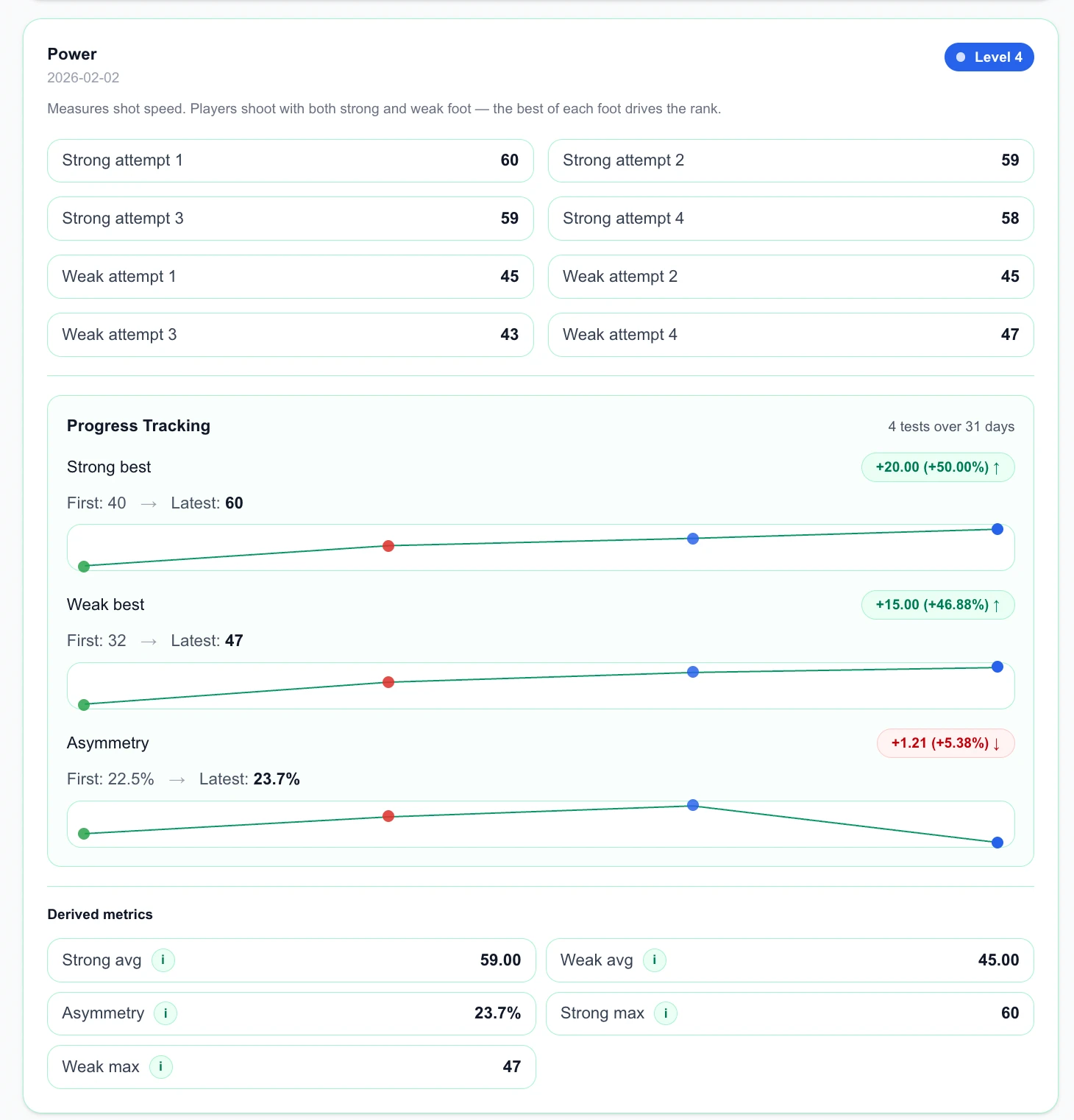
Open any test and you get the raw attempts exactly as they were recorded — not a rounded summary. Below them, the progress tracking shows the first result against the latest one, and by how much it moved.
- ✓All four attempts on each foot, saved as recorded
- ✓First result versus latest, with the change and percentage
- ✓A trend line across every test date
- ✓Derived metrics like strong and weak averages, and left-right asymmetry
Feedback & Reports
Everything the coach has written
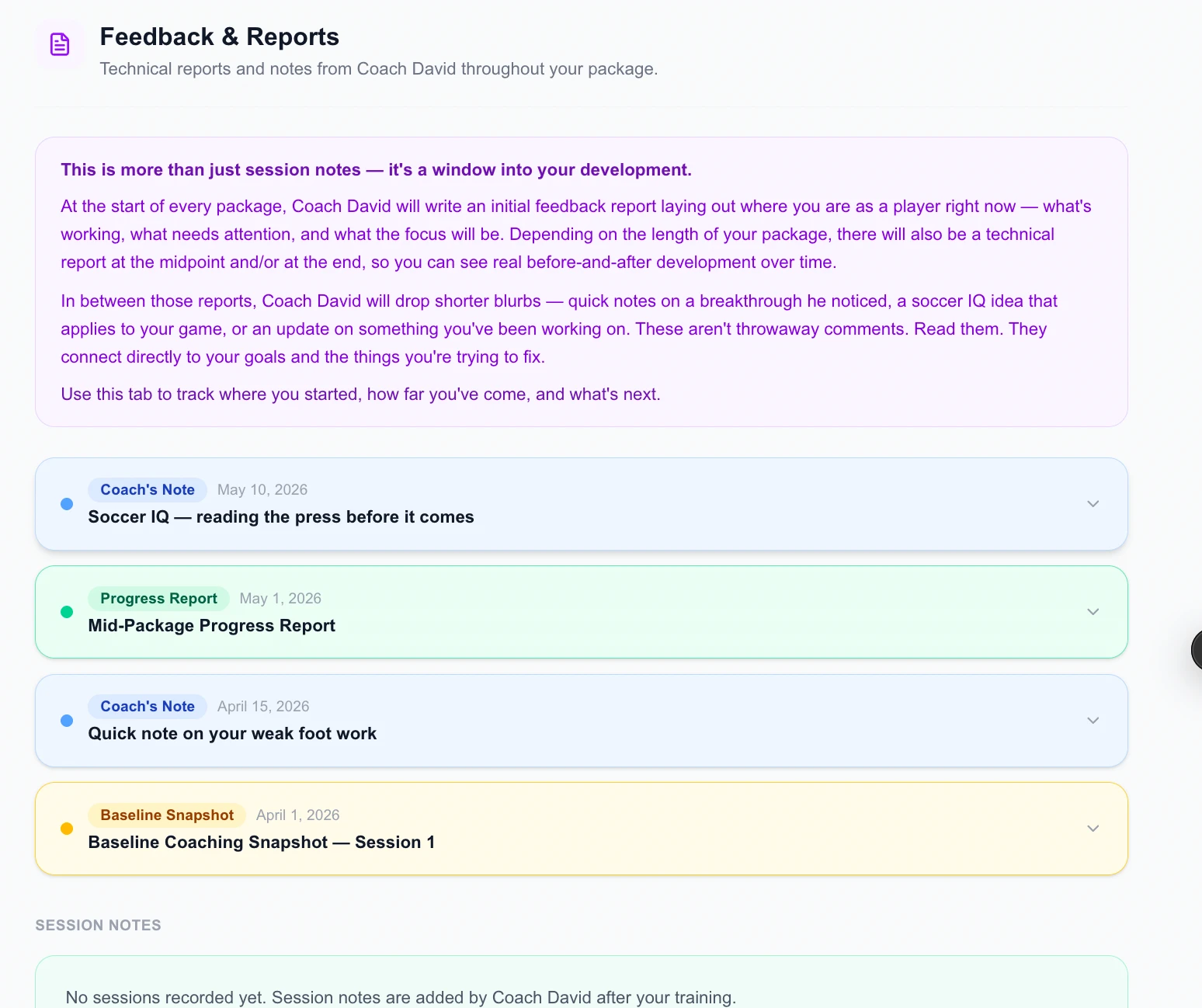
The Baseline Snapshot, every Progress Report, and every coach’s note in one dated timeline. Nothing gets lost in a text thread, and you can always go back to what was said at the start.
- ✓The Baseline Snapshot from the first sessions
- ✓Progress Reports at the checkpoints
- ✓Shorter coach’s notes in between — breakthroughs, habits, soccer IQ
- ✓Session notes attached to the sessions themselves
Goals
What to work on before next session
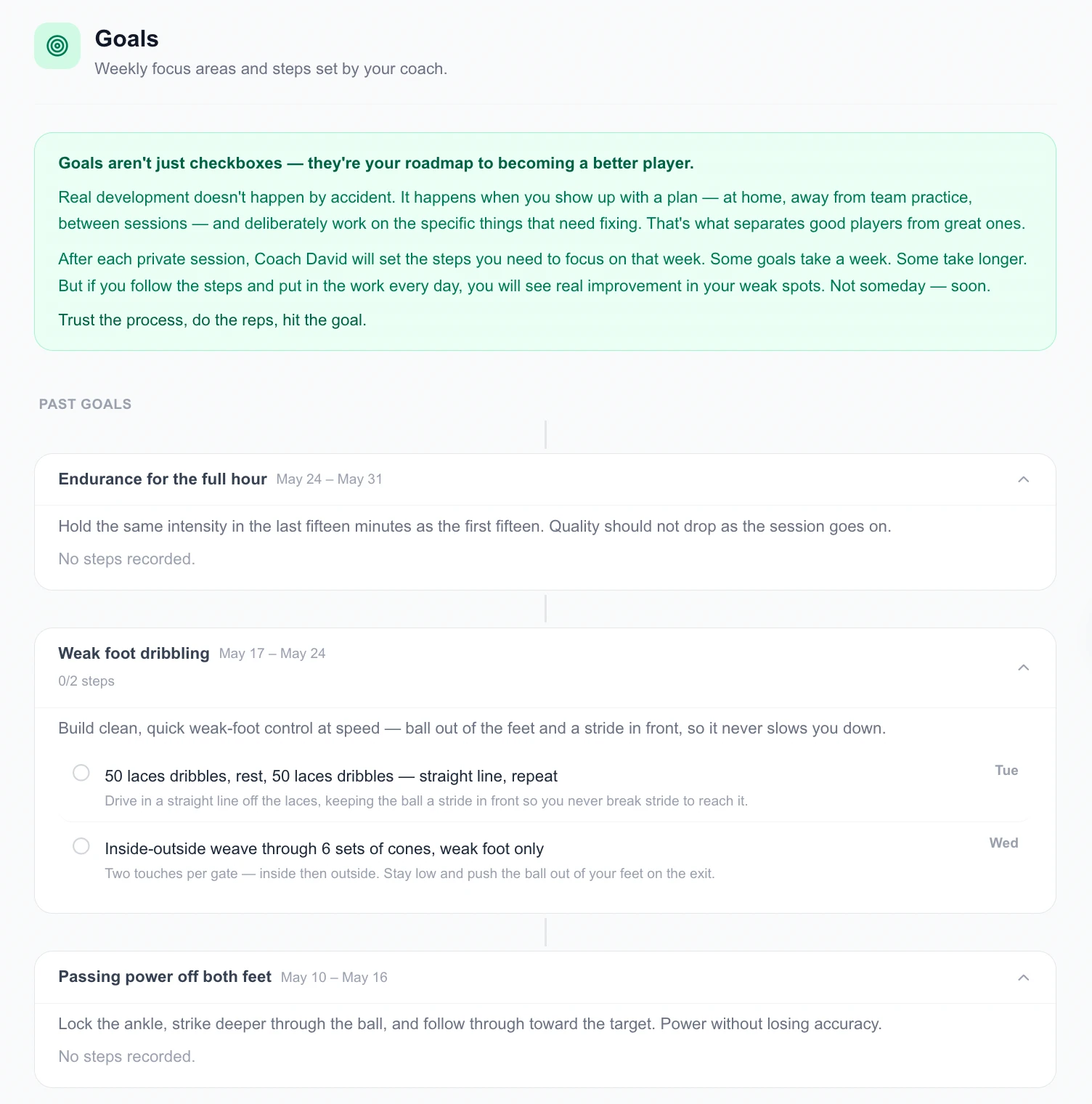
A period goal can be broken into the actual steps to do it, each assigned to a day. Players tick them off as they go, and both the current goal and every past one stay on the record.
- ✓One clear focus at a time, with a start and end date
- ✓Specific steps, assigned to specific days
- ✓Step-by-step completion tracking
- ✓A full history of past goals and how they went
Players get to see their own progress. Parents get to stop guessing.
That visibility is the whole point — it is what turns a good session into a long-term development plan.
Text us to get started
Fastest is text or WhatsApp — copy the message below and send it. Prefer a form or a quick intro call? Head to the contact page.
Hi David, my player is __ years old. Main goal is __. Best days are __. We’re in __ (Gilbert/Mesa).